
 Español
 ไทย
ไทย Melayu

Born in 1891, Philips has spanned three centuries and has undergone several major transformations.
In the late 1990s, Philips was a high-volume, technology-driven electronics manufacturer. After being affected by the technology bubble in 2000, Philips spent ten years transforming itself into a market-oriented "healthy, comfortable, quality life" company; 2015 , Philips narrowed its borders, divested its lighting business, fully focused on health technology, and integrated the health care department for the B-side and the health consumer business for the C-side.
"In the past, Philips may be considered a company that is purely a medical device, and colleagues are used to selling large and medium-sized imaging equipment." He Guowei, CEO of Philips Greater China, told Titanium Media. In the past three years, Philips' biggest improvement has been the transformation from a pure product company to a total solution service provider.
Not only is Philips in transition. With the saturation of the high-end equipment market in China and the advancement of China's medical reform, GE and Siemens are also trying to move from a single product transaction model to an overall solution.
In the wave of transformation, the three giants of medical equipment GPS (G means GE, P means Philips, and S means Siemens) meet again in the new battlefield of medical AI: GE splits its medical business and focuses on digital medical applications and solutions; Taking medical AI as a breakthrough point, Philips built its own ecological platform, merged start-ups, and integrated ecological partners; Siemens Medical is building AI capabilities from scratch, hoping to build a digital medical "Apple store".
"Whoever starts early will have a greater chance of winning market segments in the future." He Guowei said.
Single point breakthrough is difficult to generate synergy
In January 2019, Philips upgraded the business system to version 3.0, forming four major business groups: healthy living, precision diagnosis and treatment, imaging interventional treatment, and connected care, connecting patients' medical treatment processes from inside to outside the hospital.
Liang Jianqiu, head of the Greater China Region of the Interconnection Care Business Group, told Titanium Media that in the past, Philips would put different product lines in one business group to promote mutual assistance between product lines. Strong, user needs are relatively close, product characteristics are similar, can complement each other and promote them in a business group.
He Guowei added that the four business segments are for overall solutions. "In fact, we were originally an integrated department, integrating common business, and the integrated solution center can integrate many business sectors horizontally."
The performance of Philips' business segments is more directly reflected in the financial report. From the 2014-2018 financial report data, the diagnosis and treatment business contributed the largest proportion of revenue, and the contribution ratios in the past three years were 47.1%, 47.6%, and 46.2%, respectively.
Although the operating income of the personal health business is relatively stable, the growth rate is slowing. It is worth noting that the connected care and medical informatization business, although the business revenue contribution ratio is small, but showing a growth trend.
Recently, Philips announced its business development goals for 2019-2020: Mentioned that the revenue growth of the diagnostic and treatment business will remain at 5% -7%, and the profit margin will remain at 14% -16%; the connected care and medical information business, Personal health business: Revenue growth remained at 4% -6%, and profit margin remained at 16% -18%.
In mid-March, Dr. Carla Kriwet, the global leader of the Philips Connected Care Group, came to Shanghai for the first time after taking office. She revealed to Titanium Media that Philips does not consider the care business as a single product in each department, but rather considers it as a comprehensive product. ability.
"For patients with different diseases, paying attention to every aspect of the entire diagnosis and treatment process, whether in the hospital or outside the hospital, whether it is diagnostic, radiology, or emergency room, can open up the patient horizontally, which can improve the overall efficiency." Dr. Carla Kriwet said.
Unlike Philips Global, Philips China is fully localized.
Chen Shengyu, vice president of Philips Greater China, told Titanium Media that in order to adapt to the Chinese market, Philips has created a total of ten solutions for chest pain, stroke centers, tumors, respiratory sleep, critical illness and other diseases. "In the past few years, the medical equipment sold by Philips has accumulated a lot of patient information and clinical knowledge, as well as accurate algorithms. Based on this information, we can build corresponding models for disease diagnosis and risk assessment."
In these overall solutions, according to different clinical paths and scenarios, Philips connects products and solutions of various business segments in series, including establishing various databases, collecting data, collecting data, using AI to analyze relevant data, and Development of a disease scenario.
Regarding the landing of medical AI in China, Liu Shiyuan, chairman of the China Medical Imaging AI Industry-University-Research Innovation Alliance, told Titanium Media, "The current product form is only detection, and it cannot meet our entire output scenario. In addition, medical AI has not been integrated into PACS , RIS system workflow. "
Because of this, although it seems to be hard work and exhausting work, He Guowei told Titanium Media, "Single-point breakthrough is difficult to produce synergy, and the health industry increasingly emphasizes the whole process solution from the hospital to the home care. In this transformation and development In China, artificial intelligence will be the key to the breakthrough. "
Breakthrough and create ecology through AI
In the past few years, software development and AI have been the focus of Philips' strategic development. Philips invests nearly 1.7 billion euros in research and development each year, of which 60% is used for software and AI development.
But unlike the company that holds the banner of "artificial intelligence", artificial intelligence is just one link in the overall Philips solution for specialty diseases.
If distinguished by scene, there are several application scenarios of Philips' AI technology, including diagnosis and treatment,
Diagnosis and treatment scenarios: During patient imaging examinations, artificial intelligence can provide key information about biopsy results and patient medical records (such as laboratory test results, past medical history, existing radiographic reports) to improve the readings of radiologists Diagnostic capabilities.
For example, Philips has developed multiple genomics platforms to help pathologists and oncologists use a combination of genomic analysis, imaging, medical record review, and pathological section tests to customize more accurate treatment plans for patients.
Emergency care scenario: Philips developed an early warning scoring system that integrates patient data, uses smart technology to detect signs of deterioration early (sometimes 6-8 hours before an adverse event), and then alerts medical staff to help eliminate clinical decision-making processes Speculative interference in.
Taking Saratoga Hospital in New York as an example, the number of patients referred to the intensive care unit by the early warning scoring system decreased by 63%.
Remote monitoring scenario: Connected technologies such as Philips CareSage have predictive analysis capabilities to enable patient home monitoring. Analyze whether the patient's health status has changed by monitoring for abnormal patient behavior. CareSage integrates patient demographics, physical condition data and Philips Lifeline Medical alert service data to assess the likelihood of patients being admitted to the hospital within the next 30 days.
According to a study by the American Medical Alliance System Connected Medical Project, CareSage's monitoring services for 2,318 patients can reduce 224 readmissions each year, reduce the readmission rate by 40%, and save patients $ 2.2 million in treatment costs.
"The biggest application scenario of AI is to replace those often repetitive tasks, and on the other hand assist medical staff to make better decisions." Liang Jianqiu told Titanium Media. Around the disease life cycle and scenarios, Philips develops related AI products and makes a platform for others to join in and build a platform ecosystem.
Taking the "Philips Nebula Medical Imaging Artificial Intelligence Platform" as an example, in August last year, Philips announced that the platform first landed at the Bethune First Hospital of Jilin University. ) And ISD (medical research platform).
"In the past, Philips did not call Nebula an artificial intelligence platform, but Nebulas workstations." Chen Shengyu told Titanium Media, "Nebula workstations" were developed by Philips after more than a decade of research and development. This auxiliary diagnostic system has been certified by the FDA and CFDA.
At present, the platform has sold the ninth version in China, and the research and development has made the fifteenth version. The new version includes more machine learning and artificial intelligence related modules. "In the world, our installed capacity is also very large. The tenth edition in China is ready for market."
Left-hand mergers, right-hand mergers
In May last year, Titanium Media reported that Tencent Mi Ying now also includes a medical imaging artificial intelligence platform and an auxiliary diagnosis and treatment platform. In the article "Farewell to the Barbaric Period of Medical Imaging AI: Giants Make Platforms, Startups Take Segments, and Groups Explore Commercialization", it was mentioned that the two types of giants represented by Philips and Tencent have different focuses, but they are moving towards the platform layout.
But what is the difference between the ecological platforms laid by the two giants represented by Philips and Tencent?
In May 2018, Chang Jia, then the head of Tencent's Internet + medical business, told Titanium Media that the advantage of device manufacturers is the advantage of data acquisition. "But when doctors operate, many hospital departments will not use only one department. Therefore, we believe that a long-term development is needed in terms of effect and quality. In fact, we can discuss how to improve quality instead of discussing how we divide labor. "
But Zhou Zijie, head of the AI Lab of Philips China Research, believes that "we still know the real needs of doctors based on the advantages of more clinical trials and how to use this platform."
Analogous to the idea of USB interface, Zhou Zhenyu frankly stated that any company, university, or hospital can easily implant new products of clinical diagnosis ideas and store them on the platform in the form of plug-ins. "In addition to our own development of these products, we also cooperate with universities such as Cologne University and Sun Yat-sen University. They will treat their own radiotherapy, brain-computer interface, brain-computer interaction and other valuable functions in clinical practice. Valuable products are made in. "
Continuing the logic of self-built ecological platform, Philips is expanding its own ecosystem through mergers and acquisitions and cooperation.
In March, Philips announced its acquisition of Carestream Healthcare's Healthcare Information System (HCIS) business; in early April, Philips announced that it would inject "Junlian Capital Health Medical RMB Phase II Fund" to invest in medical innovation projects in China.
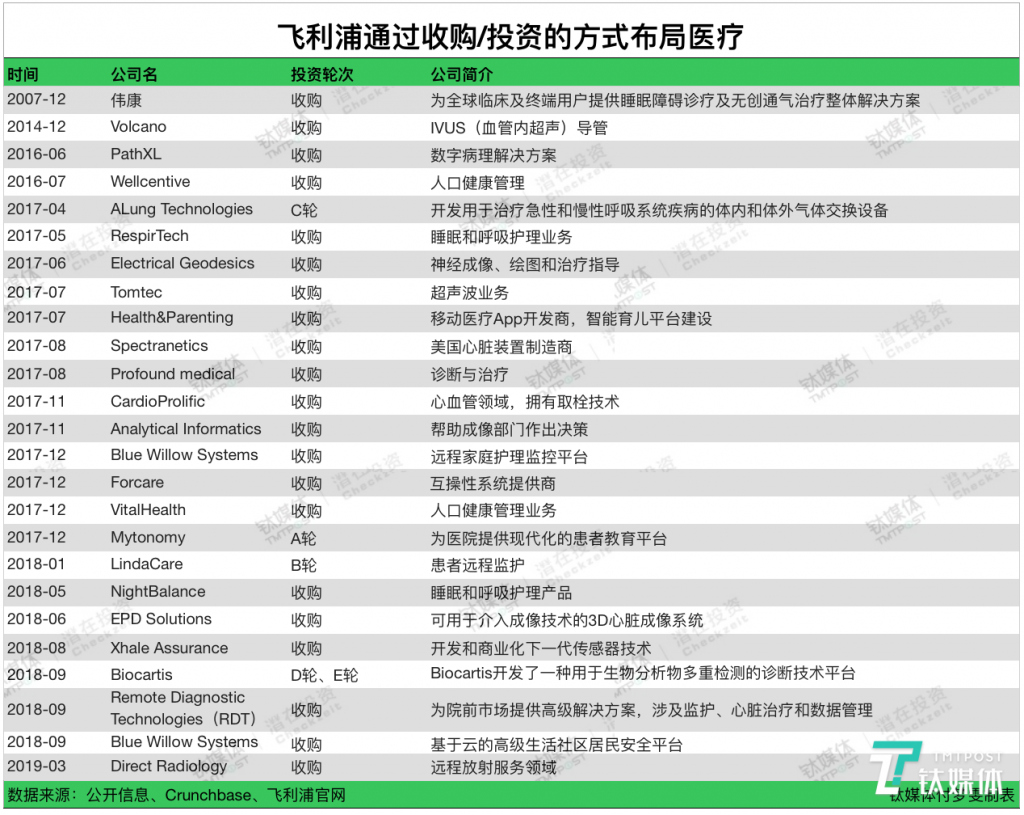
From global to China, Philips is expanding innovative businesses through mergers and acquisitions, investment and other methods. Enriching the health technology wings through acquisitions has been the way Philips has used for more than a decade.
Incomplete statistics of titanium media. Since 2007, Philips has made 25 acquisitions / investments, covering medical equipment, mobile medical, big data and other projects.
In 2017, Philips acquired VitalHealth, a cloud-based population health management company. This platform can be configured to complete a variety of out-of-hospital management health plans. With this acquisition, Philips can collect patient data more efficiently outside the hospital and apply it to the appropriate model. This is an important part of Philips' enrichment of its connected care business.
In addition to the acquisition, Philips is also strengthening its alliance with Internet giants. On March 22, Philips and Tencent started cooperation on the electronic colposcope system; three days later, Philips and Alibaba Group signed a strategic agreement.
Chen Shengyu told Titanium Media that it cooperated with Tencent and Ali from two aspects. "Tencent started from a point of view and hopes that there will be in-depth cooperation in this field, and we can jointly dig a breakthrough in artificial intelligence in this specialized disease field. With Ali is a strategic cooperation for the entire group."
In Chen Shengyu's view, the biggest advantage of Internet companies lies in the powerful role of the C-end, "and traditional medical equipment suppliers like us are lacking in this regard."
In addition to BAT, Philips also had strategic cooperation with Huawei in the past two years. Chen Shengyu admits, "There is no single company that can do everything, whether it is AI or health technology. We have worked with important domestic ecosystems and important companies in the past few years. There are many strategic cooperations. In the medical field, we have various cooperations with different alliances and different disease associations, hoping to build a healthy technology ecosystem. "
Since focusing on health technology in 2016, He Guowei believes that it is more important for Philips to do three things.
First, bring good global technology products to China; second, when bringing foreign technology to China, many clinical paths and data are not available, and the team scatters those things into comprehensive solutions; Third, Philips has transformed from a pure product company, and many customers now have a business relationship with Philips as a whole.
"We have a longer-term relationship with our partners." He Guowei said.


